

In this Field Note
An empty warehouse is a very polite Wi-Fi test environment. The racks have little stock to obstruct the signal, nobody is driving a forklift through the survey route, and the laptop has no orders to pick.
Then the warehouse starts being a warehouse.
If acceptance consists of a walk through an empty building with a capable survey adapter, the test has missed much of the job. The useful result is a supported scanner completing the intended transaction, promptly and correctly, while moving through the conditions the operation actually creates.
Make stock state part of the test
Ask what the racks hold, how full they become, and which areas change seasonally. Metalwork, dense stock, liquids, open rack space, doors, and moving vehicles affect the paths radio energy can take. A floor plan that treats every aisle as unchanged all year leaves out important design inputs.
HPE Aruba’s warehouse design guide discusses stock and rack attenuation, mounting height, and antenna placement. Its worked layouts are useful references, not permission to apply one AP spacing or mounting rule to every building.
Define a small set of representative operating states with the warehouse team: commissioning before stock arrives, normal stock, a difficult high-stock condition, and any distinctive loading or seasonal arrangement. Record which states can be tested now and which require later validation.
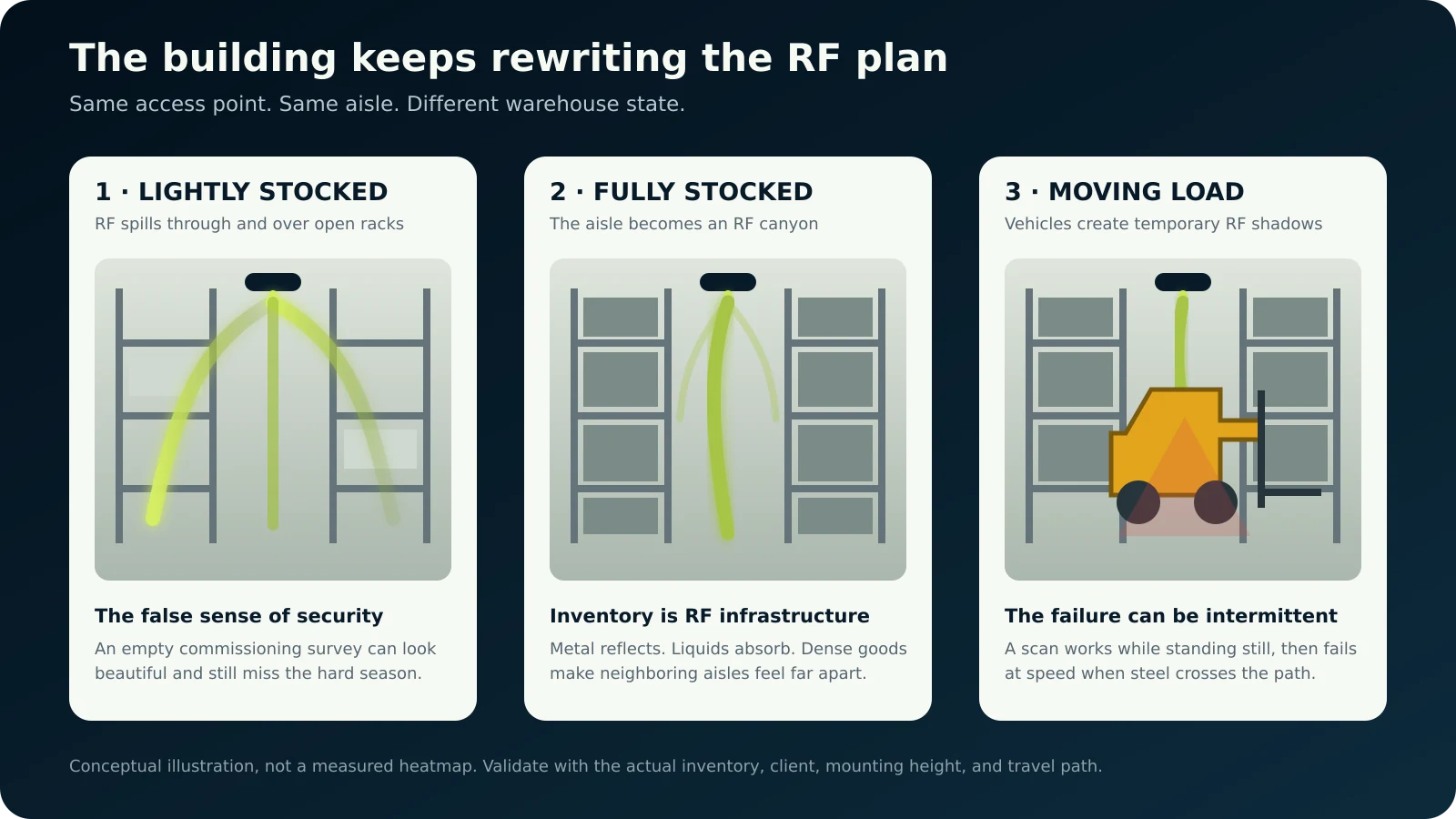
An empty-building test is still useful for checking installation, basic coverage, and wired services. Label it as that milestone. Leave a defined acceptance task for the loaded facility rather than letting provisional results become permanent approval.
Borrow the scanner and the workflow
Make a client matrix with model, operating-system build, radio firmware, supported bands, authentication, power mode, case, and mounting position. Include the oldest device the business actually intends to support. “All our scanners are the same brand” is not a compatibility matrix.
Test handhelds as people hold them and vehicle-mounted devices in their installed orientation. A body, case, or nearby metal can change the link. Safe vehicle operation remains the site’s responsibility; an authorized operator should handle the vehicle while observations are collected.
For Zebra equipment, Wi-Fi Manager’s documentation identifies model and software requirements for its controls and cautions about advanced settings. Confirm support before distributing a profile. A configuration accepted by one generation does not establish that the rest of the fleet behaves the same way.
Next, define the application action. “Send traffic” is too vague. “Scan the approved test label, obtain the response, and confirm that the test system recorded one transaction” is much easier to assess. Coordinate a test workflow with the application owner so testing does not create duplicate orders, change real inventory, or interfere with production.
Use a repeatable route card
Choose routes that represent picking, cross-aisle travel, receiving, loading, and other important movements. Give each route fixed waypoints and a direction. Test reverse travel where it is part of normal work; a successful roam in one direction does not establish the same result in the other.
| Record | Why it matters |
|---|---|
| Route, direction, date, and time | Lets somebody repeat the same experiment and correlate logs. |
| Stock state and unusual activity | Distinguishes changed RF conditions from changed configuration. |
| Client model, software, and power/mounting state | Identifies fleet-specific behavior. |
| Associated AP and transition events | Shows which cell served the client and when that changed. |
| Transaction result and elapsed time | Measures the operation the worker needs to complete. |
| Retries, radio quality, and relevant wired events | Provides supporting evidence for a failed or delayed transaction. |
Agree acceptable results before changing the WLAN. Include the permitted transaction delay, interruption behavior, and repeatability expected by the application owner. Signal strength and secondary coverage help explain the result; they should not replace the transaction test.
Put the antenna pattern to work
Review the exact antenna’s pattern, mounting instructions, height, orientation, and intended service area. Directional coverage may suit an aisle or a defined zone. Omnidirectional coverage may suit a more open area. Neither choice follows automatically from the word “warehouse.”
Where practical, validate a proposed mounting position with a temporary installation before committing to cabling and lifts. Check adjacent aisles and cross-aisle transitions, not just the point directly under the AP. The client still needs a suitable candidate when it leaves that comfortable spot.
Coordinate environmental and physical requirements with the field team: temperature, condensation, dust, impact protection, cable routes, and safe maintenance access. An electrically suitable AP in a physically unsuitable installation is still the wrong solution.
Keep power adjustments bounded and measurable. Increasing power can extend unwanted overlap; decreasing it can strand the weakest supported client behind stock. Re-run the same route after a change and check both directions of communication.
Roaming is a client-and-network test
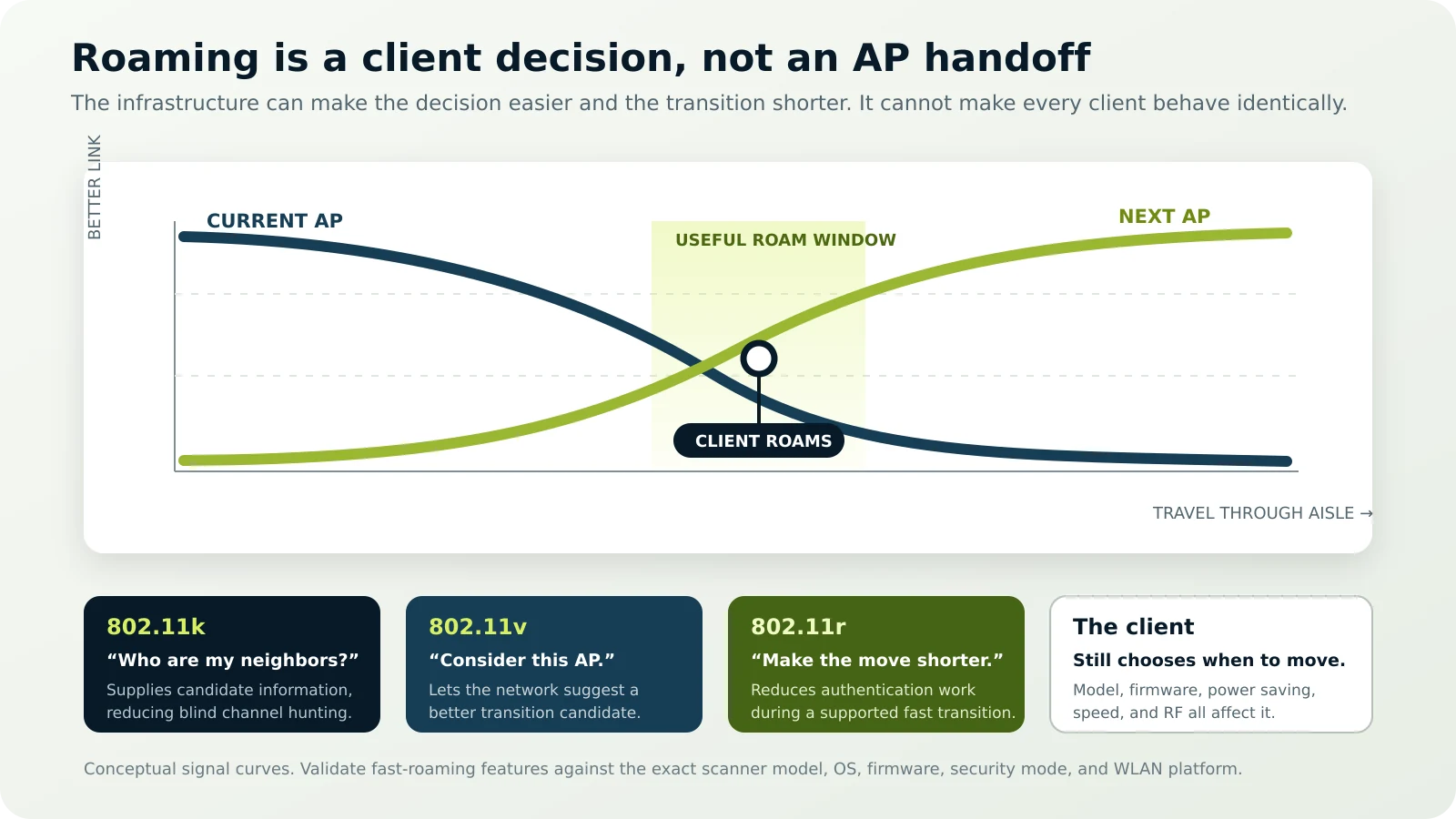
The client normally chooses when to roam. Supported assistance can provide neighbor information, suggest candidates, or reduce authentication work during a transition. Those features still need to agree with the client’s software and the WLAN’s security design.
Validate the actual fleet before enabling a new fast-transition policy across production. If you adjust a minimum signal or disconnection threshold, verify that a usable destination exists. Forcing a struggling client off an AP does not manufacture coverage elsewhere.
Use channel width to support the workload and channel reuse. A 20 MHz design can be a sensible starting point for a 5 GHz scanner deployment with modest throughput needs; it is not a rule for every warehouse. The HPE Aruba RF guide discusses that distribution-center tradeoff. Validate against the actual spectrum, clients, and demand.
Also verify addressing and mobility behavior across the route. A shared SSID does not, on its own, guarantee that a client retains the network context its application expects.
Follow the stall out of the aisle
When a transaction fails, collect its time and location before resetting the client. Then compare the radio event with authentication, DHCP, DNS, switch errors, PoE, firewall, WAN, and application observations.
If every scanner pauses together, investigate shared dependencies. If one model fails at a transition that others handle, investigate that model’s software, authentication, and roaming behavior. If trouble appears only with loaded racks, compare candidate APs and retry behavior in that stock state. These are hypotheses to test, not diagnoses made from a symptom alone.
Preserve the evidence before changing several settings. A device reset may restore work, but record that action and whether the fault returns. Otherwise, the next engineer inherits a network with excellent reboot statistics and little explanation.
Keep scanner, guest, office, camera, and operational access aligned with their actual needs. Test the required application flows and the intended boundaries. A workaround for one legacy client should have a narrow scope and a clear owner.
Accept the working warehouse
Deliver the client matrix, mounting and antenna plan, channel/power settings, route cards, stock conditions, results, and unresolved limitations. Repeat the critical test when a material client update, layout change, or new stock pattern challenges the original assumptions.
If you are investigating internally, begin with one troublesome route, one affected client, and a repeatable application test. That usually produces a better conversation with the WLAN or device vendor than a screenshot of a speed test.
If the building works until it fills up or different teams keep handing the fault to one another, Oaktown Tech can assess the wireless and wired service path together. The acceptance result should be a completed scan and a moving order, under conditions the warehouse can recognize as its own.
Join the discussion