
Monitoring and reliability
See what failed. Know what to do next.
A wall of device alarms leaves the operator with another job. Useful monitoring explains which service is affected, what it depends on, and where to begin.
Start with a short message. Charles will follow up personally. The initial conversation is at no charge.
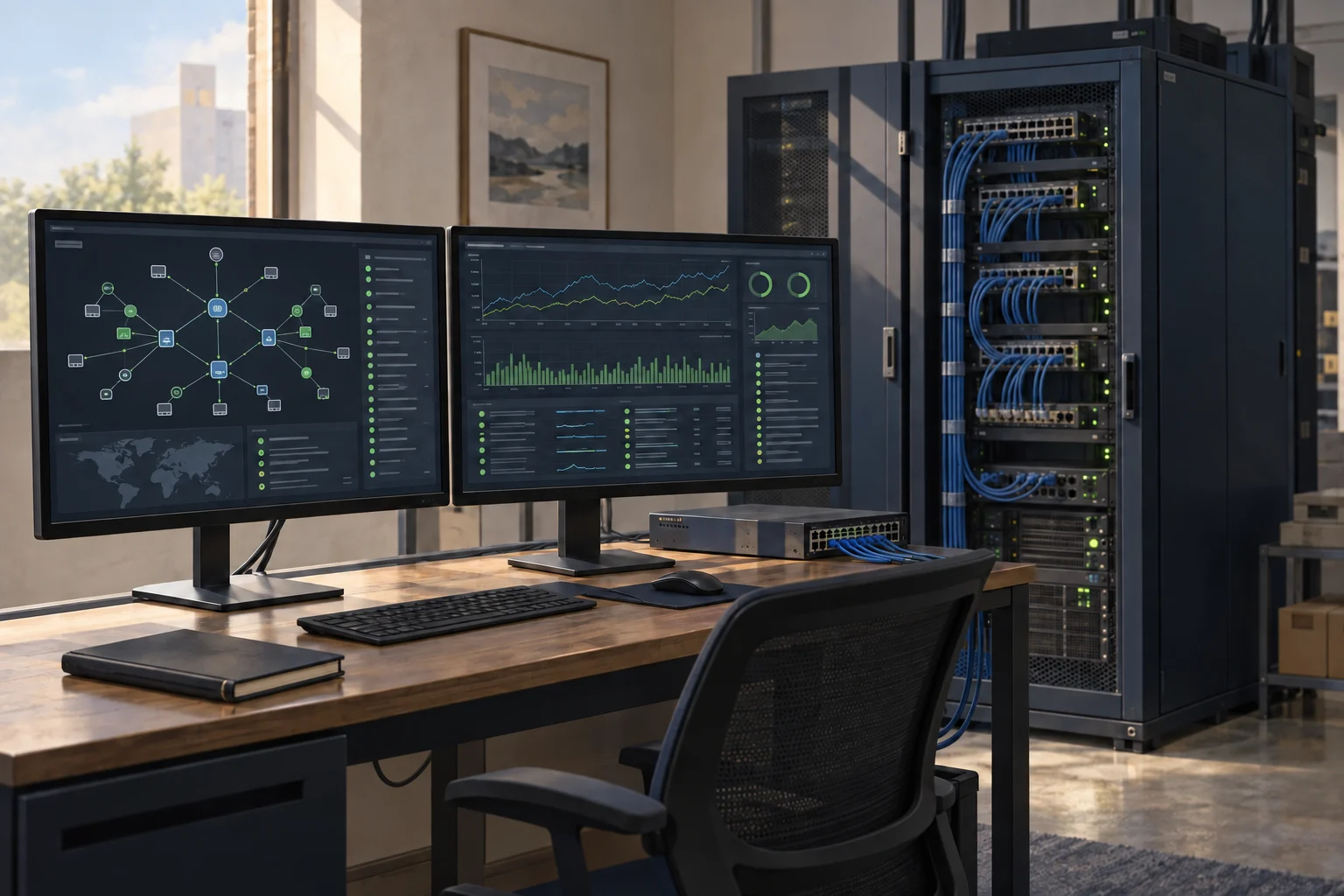
Start with the decision behind the alert.
When a remote site disappears, the team needs to distinguish a failed backhaul from a power problem, a management failure, or an individual device. That requires a dependency map, relevant measurements, and an alert policy that reflects how the network operates.
Oaktown Tech builds or improves that operating picture. The work can address intermittent outages, missing history, noisy alerts, uncertain configuration backups, or a network that has grown faster than its documentation.
Put the evidence where it will be useful.
Topology and dependencies
Record which links, devices, services, and power sources stand between the observer and the equipment being monitored.
Measurements and history
Collect the traffic, errors, radio condition, device health, and timing needed to investigate the faults that matter in this environment.
Actionable notifications
Define thresholds, duration, maintenance behavior, routing, and escalation. An alert should have an owner and a useful next step.
Configuration recovery
Capture and version supported configurations, protect sensitive contents, check collection jobs, and establish what restoration requires.
A saved file is the beginning of recovery.
A replacement may depend on software, licenses, interface mappings, certificates, or a console connection as well as a configuration. Document those requirements and test an appropriate restore procedure. Keep recovery information accessible during the failures it is meant to address.
Monitoring should also reveal when its own assumptions stop being true. Missing backups, stale measurements, and an expired maintenance window deserve attention before the next production incident.
Choose the support the team actually needs.
A project can establish monitoring and hand it over, or include separately scoped ongoing monitoring and configuration backup. Device coverage, retention, access, alert routing, and responsibilities are agreed around the operating team.
This service does not include a 24/7 NOC or SOC, unlimited administration, guaranteed incident response, or a required engineering retainer. A defined monitoring arrangement can still provide a valuable safety net.
Let’s talk about the work
Make the next alert more useful.
Tell Charles what fails, what your team can currently see, and who is responsible for responding.
Start with a short message. Charles will follow up personally. The initial conversation is at no charge.